
The Lost Baggage Guide: From Delayed to Declared Lost
How airlines actually classify a missing bag as it moves from delayed to lost, what documentation you need at each stage, and how liability limits and travel insurance interact.
13 min read · Updated March 2025

A missing suitcase rarely announces itself as a genuine loss right away. It usually starts the same way almost every delayed bag starts: you stand at the carousel at JFK or Heathrow, watch the last few bags circle past, and eventually accept that yours is not coming out today. What separates an ordinary delay, the kind resolved within 24 to 48 hours, from a bag that is eventually declared lost is a slow, mostly invisible escalation inside the airline's tracing system, and understanding that escalation is the difference between a smooth claim and a frustrating one.
This guide walks through that escalation from the moment you notice a bag is missing to the point, weeks later in the worst cases, where an airline formally accepts it cannot be found. Along the way we cover the documentation that actually moves a claim forward, how liability limits work in broad terms, what interim expenses you can reasonably claim while you wait, and how travel insurance fits around whatever the airline eventually offers.
Stage one: the delayed bag, day zero to about five days
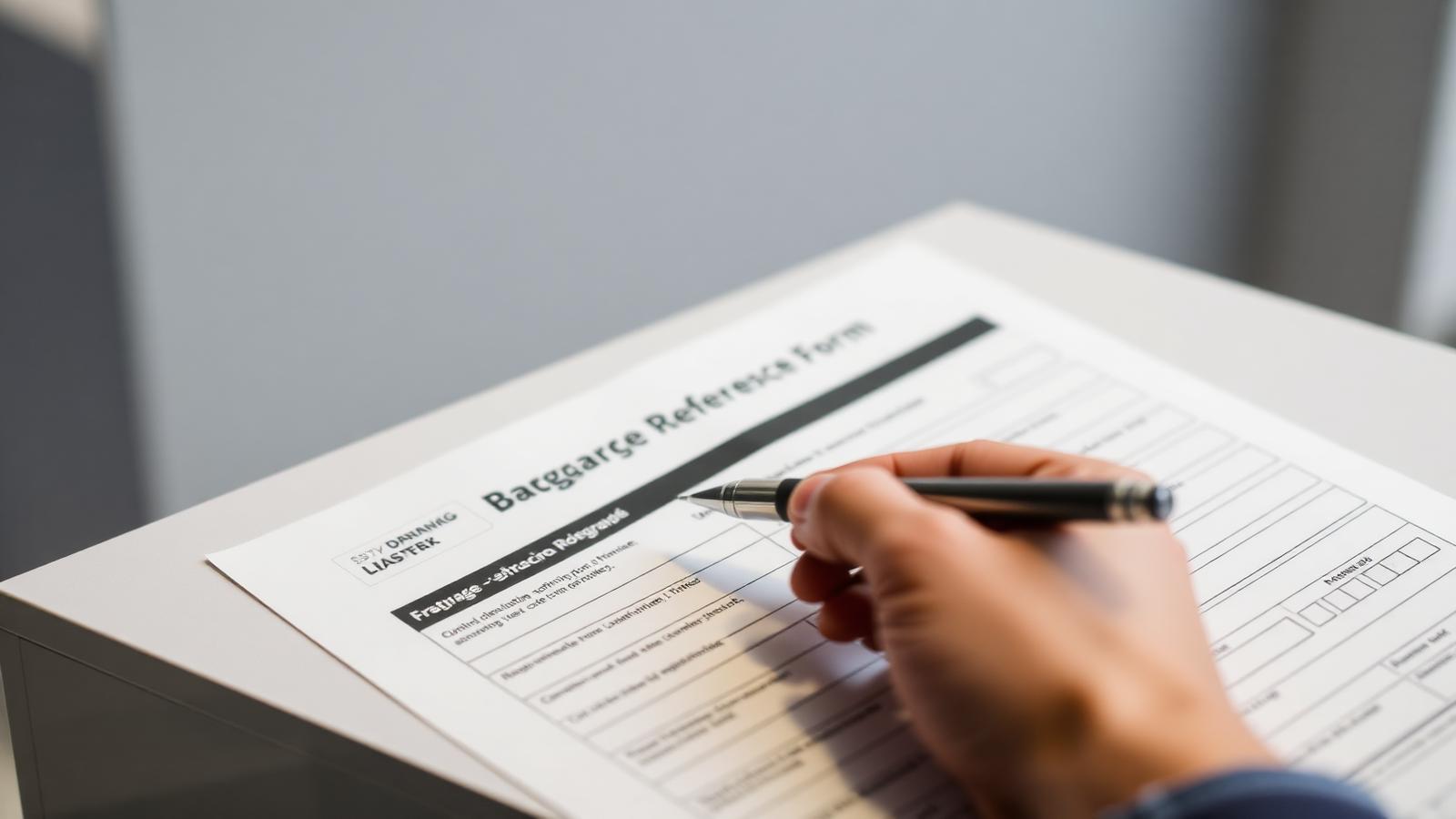
The moment you realise your bag has not arrived, go straight to the baggage service desk before you leave the arrivals hall, not the airline's general check-in counter, which usually cannot help with tracing at all. You will file what is typically called a property irregularity report, sometimes shortened to a PIR, and you will walk away with a reference number. Treat that number as the single most valuable piece of paper from the entire trip. Every phone call, email and web update afterward is tied to it.
At this stage, most airlines classify the bag as delayed rather than lost. Statistically, this is where the overwhelming majority of missing bags resolve themselves. A bag that missed a tight connection in Frankfurt or Chicago, was misrouted onto the wrong flight, or simply did not make it onto the belt loader in time usually turns up within one to three days and is delivered to your hotel or home by a contracted courier. For a fuller walkthrough of this earlier phase, including what to buy and how delivery logistics usually work, see our delayed baggage guide, which covers the first days in more depth than we will here.
Stage two: active tracing, roughly five to fourteen days
If a bag has not surfaced within the first few days, most airlines shift it into an active tracing phase. This usually means the bag's tag has been checked against every flight it could conceivably have been loaded onto, staff at connecting hubs have been asked to physically search unclaimed bag rooms, and the airline's central baggage tracing system, often a shared industry platform called WorldTracer that many carriers including American, British Airways, Lufthansa and Emirates all use, is pinging for a match.
This is the stage where your own documentation starts to matter. Keep a written log of every phone call, including the date, the name of whoever you spoke to, and what they told you. If you used a Bluetooth tracker such as an AirTag inside the bag, note down the last known location and timestamp, since this can occasionally help staff narrow down which sorting facility or connecting flight the bag was misrouted through. It is not proof the airline is obligated to act on, but it has genuinely sped up a number of recoveries by giving ground staff a specific area to search rather than an entire terminal.
During this window you are also entitled, on most airlines and under most regimes, to reasonable interim expenses: a change of clothes, toiletries, and other essentials you would not have needed if your luggage had arrived. Keep every receipt. This claim is separate from, and usually processed faster than, any eventual lost bag settlement, so submit it on its own rather than waiting to bundle everything together at the end.
Stage three: the bag is declared lost
There is no universal industry deadline, but most carriers move a bag from delayed to formally lost somewhere between two and three weeks after the original report, once active tracing has been exhausted. At that point the airline will typically send a letter or claim form and ask you to submit a full inventory of the bag's contents along with proof of value where you have it. This is the point where the Montreal Convention becomes relevant for most international itineraries.
The Convention sets a liability ceiling for checked baggage, expressed in Special Drawing Rights, an accounting unit used by the International Monetary Fund, rather than a fixed number of dollars or euros, which is why the equivalent local currency figure moves slightly over time with exchange rates. It is worth being clear about what this cap actually is: a maximum the airline cannot be forced to exceed under the Convention, not a fixed amount every claim receives, and not a guarantee that you will be paid that full sum. You still need to demonstrate what was in the bag and roughly what it was worth, and airlines will apply depreciation to used items rather than paying original retail prices.
Purely domestic tickets in some countries, where no international leg is involved, may fall under a different national liability scheme rather than the Montreal Convention, so it is worth checking your specific carrier's conditions of carriage rather than assuming one regime applies everywhere. This is also a moment where it helps to have read the general framework behind checked luggage rules in the first place, which our checked baggage guide covers, since it explains what airlines consider acceptable to check versus what should never have gone in the hold to begin with, which matters when a claim is assessed.
Building a claim that actually gets paid promptly
The single biggest driver of a slow or disappointing settlement is a vague inventory. "Clothes and toiletries, approximately $800" invites a lowball counter-offer. A structured list, item by item, with approximate purchase dates and prices, supported by whatever receipts, bank statements, or even photos from earlier in the trip you can find showing the items, moves far faster through an airline's claims team.
- The property irregularity report number from the airport, quoted on every subsequent contact
- A dated, itemised inventory of everything in the bag, with an approximate value for each item
- Original receipts or bank statements for higher value items, where available
- Photos of the bag itself, ideally taken before the trip, showing its condition and any distinctive tags
- Copies of every interim expense receipt, kept separate from the main lost bag claim
- A written log of dates, names and reference numbers for every call or email with the airline
- Your original baggage tag stub, usually stapled inside your boarding pass folder or ticket receipt
Submit the claim through the airline's official baggage claims channel rather than a general customer service email address, since it will otherwise sit in a queue that is not designed to process liability claims. If you are struggling to get a response at all, our guide on contacting an airline successfully has specific approaches, such as using social media escalation or airport lost-and-found desks directly, that tend to get a faster human response than a web form.

Where travel insurance fits in
Most annual and single-trip travel insurance policies treat baggage loss as secondary cover, meaning they expect you to claim from the airline first and will only cover the shortfall between what the airline paid and your policy's own baggage limit, rather than duplicating the payout. Insurers will typically want the airline's final settlement letter as part of your file, so do not submit to your insurer until that letter exists, or at minimum note that a claim is in progress with the airline.
It is also worth checking whether your policy has category sub-limits, common ones cap cash, electronics, or single items above a certain value, which can matter more than the headline overall baggage figure if you had a laptop or jewellery inside the bag. Read the policy wording rather than assuming the round number on the summary page applies to everything equally.
Three worked scenarios
A traveller flying American Airlines from JFK to LAX with a checked bag that never made the aircraft after a tight same-day aircraft swap spent nine days in active tracing before the airline sent a formal lost bag claim form. The bag turned up on day eleven in a bin room at DFW, having been sorted onto the wrong domestic feeder days earlier, and was couriered out the same afternoon it was found, before the claim settlement was ever finalised.
A traveller connecting through Frankfurt on Lufthansa, with an onward flight to Nairobi, had a bag that missed the international transfer entirely because the inbound flight landed at a remote stand requiring a bus. FRA's tracing team located it within 48 hours, well inside the delayed phase, and it was delivered to the traveller's hotel. This is the far more common outcome than an outright loss, and it is worth remembering while the first few days feel alarming.
A third traveller flying British Airways out of Heathrow, with checked bags on a codeshare operated by an Oneworld partner, had a bag genuinely go missing for three weeks after a tag was damaged in transit and could not be scanned at a connecting point. In that case, the airline moved the claim to a formal lost declaration at day nineteen and settled on a itemised inventory within a further ten days. The traveller's dated photos of the bag's contents, taken before departure for an unrelated reason, ended up being the single most useful piece of evidence in the claim.
Exact wording for a written claim
When you submit the formal lost bag claim, a short, factual message tends to move faster than a long emotional one. Something close to this works well: "I am writing to follow up on property irregularity report [reference number], filed on [date] at [airport]. The bag has not been located after [number] days of tracing. I am attaching an itemised inventory with approximate values and supporting receipts where available. Please confirm the status of this claim and the airline's proposed settlement." Attach the inventory as its own document rather than pasting it into the body of the email, since claims teams often process attachments separately from the message text.
Common mistakes that slow a claim down
- Waiting until the bag is declared lost before starting the inventory, instead of building it as soon as you suspect a real delay.
- Submitting a round-number estimate of total value instead of a line-by-line list, which almost always triggers a lowball counter-offer.
- Mixing interim expense receipts into the same claim as the lost bag inventory, which are usually processed by different teams on different timelines.
- Assuming a codeshare flight means the marketing airline, rather than the operating carrier, is holding the bag in its tracing system.
- Giving up on the claim after a low first offer instead of responding with a more detailed inventory.
Edge cases: codeshares, separate tickets and terminal changes
On a codeshare, your bag is tagged and tracked by the operating airline's system even if your ticket and boarding pass show a different marketing airline's flight number. If you call the airline printed on your ticket and they say they have no record, ask them to search using the actual operating flight number instead, since that is usually where the tracing entry lives.
On separate tickets, each airline is only responsible for the bag it checked. If you self-connect, for example arriving at Charles de Gaulle on one ticket and departing on an unrelated onward booking, you typically have to collect, clear customs on, and recheck your own bag between the two. A bag lost on the second, separately booked leg is not the first airline's liability at all, even if the original delay that caused you to rush the recheck was on their flight.
A terminal change mid-journey, such as connecting between a domestic and an international flight at a large hub, adds another point where a bag can be misrouted, since it may have to be pulled from one system, physically moved, and rescanned into another rather than simply riding through on a single belt. If your itinerary involves a terminal change and your bag goes missing, it is worth telling the tracing desk exactly where the change occurred, since that narrows the search considerably.
A short checklist for the whole process
- File the property irregularity report before leaving the airport, and keep the reference number
- Photograph and log the last tracker location if you used one
- Submit interim expense receipts as they happen, separately from any eventual lost bag claim
- Build a detailed inventory as soon as you suspect the bag will not simply turn up in a day or two
- Wait for the airline's formal lost declaration before submitting the full claim, but keep chasing tracing in the meantime
- Only involve your travel insurer once you have an airline reference and, ideally, a settlement figure
Most missing bags do resolve before ever reaching a formal lost declaration, but treating every delay as though it might escalate, by documenting from day one, saves considerable stress if the days stretch into weeks. If the disruption started with a cancelled or heavily rescheduled flight in the first place, it is also worth reading our guide on what to do when your flight is cancelled, since misrouted baggage is disproportionately common on itineraries that were rebooked at short notice. For everything else Fix Station covers on the ground once things have already gone wrong, the Fix Station hub is the place to start.
Frequently asked questions
Related articles
Keep reading across the network

Fix Station · 12 min read
Delayed Baggage: The First 24 Hours and What Comes After
What to do in the first day after your checked bag fails to arrive, what you can reasonably buy and claim back, and how delivery to your hotel or home usually works.

Fix Station · 12 min read
Damaged Luggage: Problem, Solution, Outcome
A practical, three-part walkthrough of dealing with damaged checked luggage, from the reporting window at the carousel to repair, replacement, and depreciation.

Fix Station · 14 min read
Flight Delay Survival Guide
How to handle a flight delay by length, from a 30 minute wait to an overnight cancellation, including duty of care, vouchers, and when it makes sense to rebook yourself.